
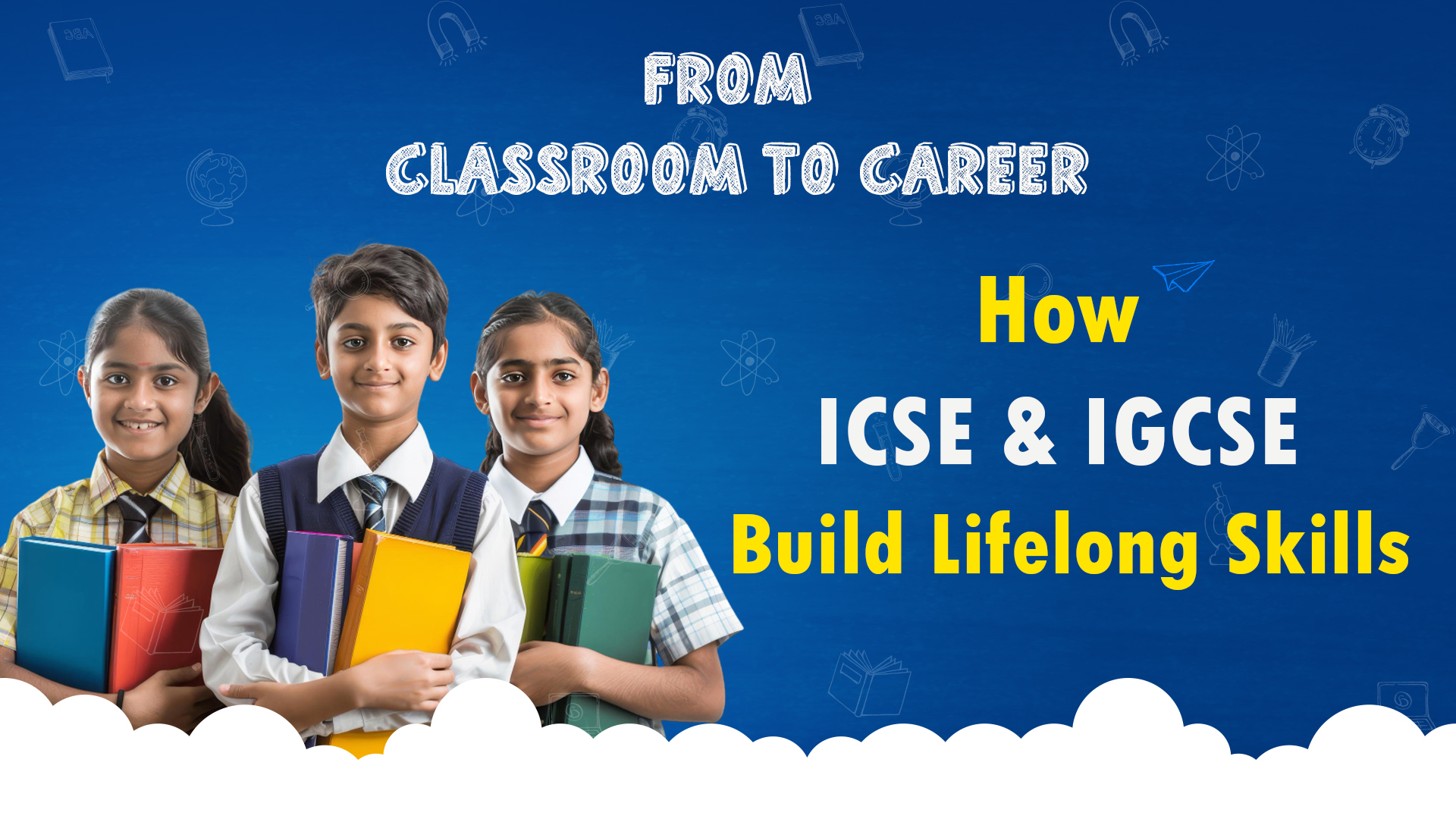
From Classroom to Career: How ICSE & IGCSE Build Lifelong Skills
Introduction: Education Beyond Exams
In a world where automation, AI, and global competition redefine success every day, the real question parents ask is no longer “Which board helps my child score more?” but “Which board prepares my child for life beyond school?”
ICSE and IGCSE stand out because they view education as a journey of building thinkers, creators, and collaborators, not just test-takers. Their classroom experiences mirror real-world challenges — projects, discussions, experiments, and presentations that prepare students to lead with confidence in university, entrepreneurship, and any career they choose.
Let’s explore how these boards are quietly shaping tomorrow’s leaders — one classroom at a time.
The Link Between School Learning and Career Skills
Education is often seen as a means to an end, grades, marks, and college admissions. But the best schools know that career success begins in classrooms that value reasoning over rote, and initiative over imitation.
Unlike traditional models that focus on memorization, ICSE and IGCSE emphasize the process of learning, asking, exploring, and applying. This shift from “What to learn” to “How to learn” gives students an unmatched advantage in the real world.
How This Translates to Career Growth
- Critical thinking leads to faster problem-solving in real-world scenarios.
- Research and analysis develop evidence-based decision-making, vital in corporate, creative, and scientific careers.
- Communication and presentation skills help students express ideas clearly, a must in global workplaces.
- Time and project management through coursework prepares students for multitasking and accountability.
Both ICSE and IGCSE are built on these outcomes, and that’s why their students adapt seamlessly to changing professional environments.
ICSE & IGCSE Skillsets: Analysis, Innovation, Collaboration
Analytical Thinking That Drives Innovation
In ICSE and IGCSE classrooms, lessons go beyond textbooks. Students interpret data, write reports, and evaluate outcomes exactly like professionals analyzing business or social trends.
For example, in an IGCSE economics class, students debate real trade policies, while ICSE learners in environmental science projects collect and present field data.
These aren’t just academic tasks; they mirror the kind of research-driven reasoning top employers seek.
Creativity Through Interdisciplinary Learning
Both boards encourage students to blend subjects. A literature lesson may lead to a short film project; a physics concept may inspire a design prototype.
This interdisciplinary flexibility nurtures innovation, the same skill that defines leaders in technology, design, and entrepreneurship.
In particular, IGCSE’s subject flexibility allows students to pursue art, technology, or global perspectives alongside core sciences, creating balanced individuals who think beyond silos.
Collaboration and Communication
Group projects, oral presentations, and peer feedback are at the heart of both curricula.
Students learn to:
- Debate respectfully
- Share responsibilities
- Present findings clearly
Such experiences develop emotional intelligence and teamwork, the traits that drive leadership in any career.
Real-World Applications of Classroom Learning
Theory meets practice in ICSE and IGCSE classrooms. From science experiments and business simulations to creative writing and digital media projects, students experience what it means to apply knowledge with purpose.
Sample Classroom Experiences
- ICSE Science: Students model sustainable ecosystems using recycled materials, introducing them to design thinking and environmental problem-solving.
- IGCSE Business Studies: Learners create mock startups, developing pricing strategies and marketing plans.
- ICSE English: Students publish digital journals integrating language skills with media literacy.
- IGCSE Global Perspectives: Projects on global challenges train students to view issues through social, economic, and ethical lenses.
These experiences bridge the gap between academic learning and practical intelligence, creating learners who are confident, articulate, and globally aware.
Beyond the Classroom
Across India and the world, ICSE and IGCSE students can stand out not just for their academic record but for their leadership and adaptability.
They’re excelling as engineers who communicate creatively, designers who think analytically, entrepreneurs who lead with empathy, and researchers who innovate with purpose.
Their foundation in analytical writing, practical projects, and research-based learning gives them the versatility to succeed in any professional or cultural setting.
Many global employers, from tech firms to consulting agencies, often note that candidates with Cambridge (IGCSE) or ICSE backgrounds tend to learn faster, think broadly, and lead better.
Why Employers Value IB, IGCSE & ICSE Backgrounds
In a digital, fast-moving economy, recruiters are less impressed by what you know and more by how you think, solve, and adapt.
Employers recognize that IGCSE and ICSE students:
- Handle ambiguity with confidence
- Communicate ideas clearly in global teams
- Adapt quickly to new systems or technologies
- Show initiative and curiosity, vital in leadership roles
The Cambridge IGCSE especially aligns with international university and career expectations, as it emphasizes independent learning, research ethics, and global awareness qualities that set students apart in competitive markets.
How Agasthya School Nurtures Future-Ready Learners
At Agasthya Public School, the goal isn’t just academic success, it’s shaping self-motivated learners ready to thrive anywhere.
- Integrated Skill Curriculum: Students participate in annual project expos, STEAM fests, and innovation labs.
- Career Exposure: Workshops connect classroom subjects to real-world professions.
- Mentorship Programs: Teachers guide students in time management, goal-setting, and public speaking.
- Global Outlook: Through Cambridge-based learning, students learn to think critically and act globally, without losing their cultural roots.
Agasthya’s commitment ensures that every student’s journey, from classroom to career, is guided by curiosity, confidence, and character.
Tips for Parents: Encouraging Career-Smart Learning at Home
- Ask “why” questions to build reasoning habits.
- Encourage projects and exploration beyond school homework.
- Discuss real-world issues and link school topics to everyday life.
- Value effort and creativity over just scores.
Parents who nurture these habits at home often see their children become more independent learners, the true goal of both ICSE and IGCSE education.
Conclusion: The New Definition of Success
The future belongs to learners who can adapt, create, and lead, not just memorize and repeat.
ICSE and IGCSE aren’t just school boards; they are mindset builders. They equip students with the skills and confidence to face real challenges in college, in careers, and in life.
If your vision for your child goes beyond marks toward a future of creativity, leadership, and lifelong learning, it’s time to look deeper into what these boards truly offer.
FAQs
1. How do ICSE and IGCSE help in future careers?
They build analytical, communication, and research-based skills that are directly useful in university and work environments.
2. Are ICSE and IGCSE students at a disadvantage in Indian exams?
Not at all. In fact, the conceptual understanding they develop makes them stronger in aptitude and reasoning-based tests.
3. Do IGCSE students need to go abroad for higher education?
No. While IGCSE is globally recognized, Indian universities also accept it, and many students thrive in national institutions.
4. How can parents support this skill-based approach?
Encourage curiosity, independent thinking, and project-based exploration at home, small habits that align beautifully with both boards’ philosophies.