
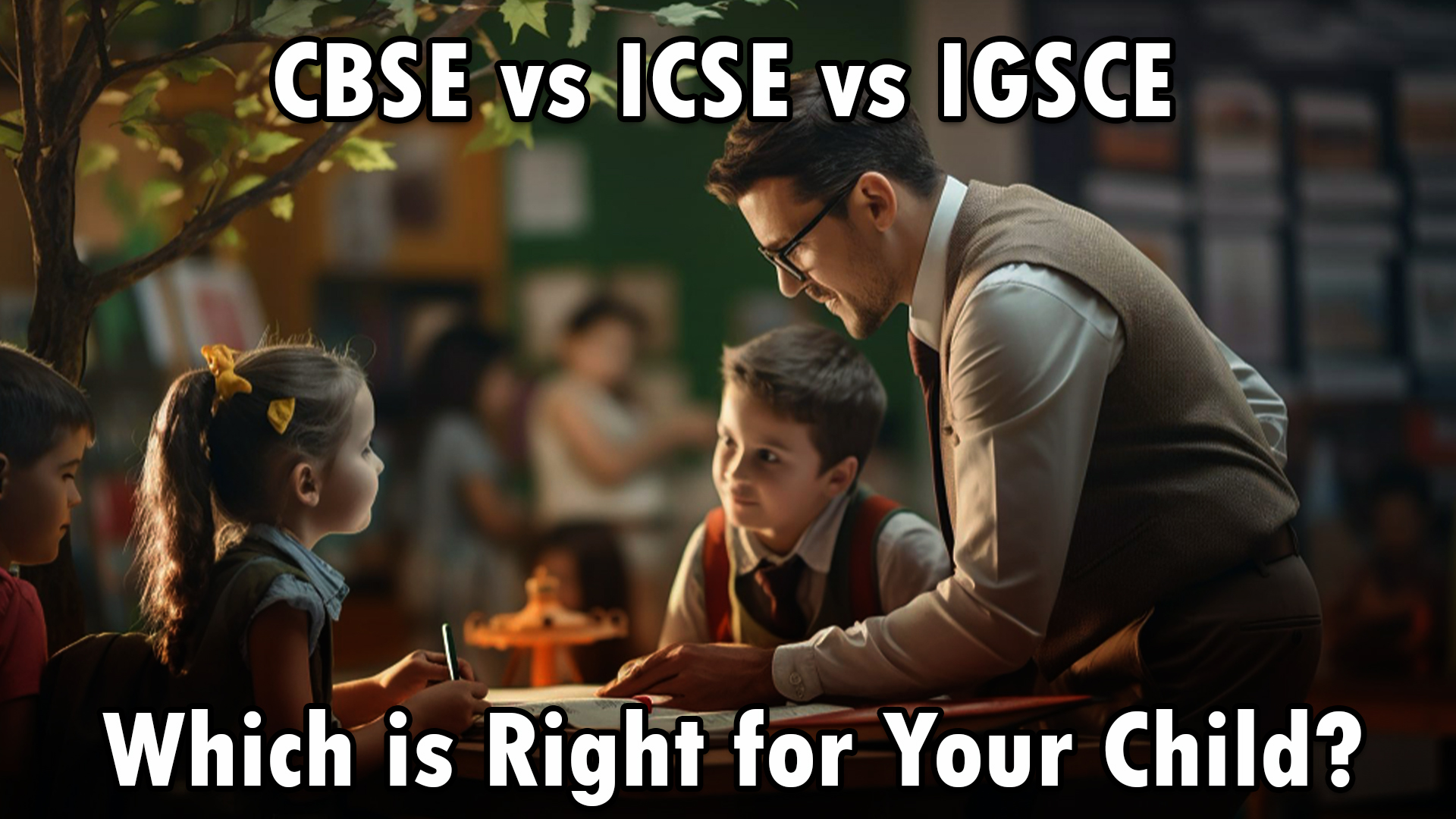
ICSE vs CBSE vs IGCSE — Which is Right for Your Child?
Introduction
Choosing the right board is one of the most important decisions a parent will make.
In India, three names often come up:
ICSE (CISCE), Cambridge IGCSE, and CBSE. Each board has its philosophy, assessment style, and strengths. A common shorthand you’ll hear is that ICSE and IGCSE encourage broader, balanced learning (strong on languages, projects, and depth), while CBSE is more streamlined toward examinations and national competitive-exam readiness. The reality, however, is more nuanced and worth unpacking so you can make the best choice for your child.
What is balanced learning?
Balanced learning emphasizes breadth and depth across disciplines, languages, humanities, sciences, arts, and co-curriculars. It favors descriptive answers, project work, laboratory learning, class presentations, and integrated assessments that develop communication, analytical thinking, and creativity, not just the ability to answer multiple-choice questions.
This approach builds both domain knowledge and transferable skills (critical thinking, research, teamwork) that matter for higher education and modern careers. ICSE’s curriculum has traditionally been recognized for this breadth and detail, especially in English and humanities.
Overview: ICSE vs IGCSE vs CBSE
- ICSE (CISCE): Broad subject choice, detailed syllabi, emphasis on the English language, and internal assessments. Works well for students who benefit from descriptive learning and strong language skills.
- IGCSE (Cambridge): Internationally framed, flexible subject choices, frequent coursework and project options; globally recognized and helpful for students aiming to study abroad.
- CBSE: Streamlined national curriculum with alignment to NCERT; historically structured to build conceptual clarity in Science & Math and to prepare students for national exams (JEE/NEET). Recent years have also seen CBSE moving towards competency-based learning.
Why ICSE & IGCSE are often called “balanced”?
1. Broader subject exposure
ICSE/ISC and IGCSE encourage students to study a wider range of subjects, including multiple languages, arts, and humanities, alongside science and math. ICSE’s syllabi are known to be detailed and descriptive, placing strong emphasis on English language and composition skills that benefit students in college essays and global communication. Cambridge IGCSE also offers a mix of coursework, practicals and extended assignments that build research and presentation skills.
2. Assessment style promotes skills
Where CBSE has more objective-style and board-exam-focused assessment, ICSE and IGCSE use a mix of written papers, coursework, projects, and oral/practical components. This encourages students to learn by doing and to demonstrate understanding in different formats a strong foundation for higher education and interdisciplinary problem solving.
3. Emphasis on language & communication
ICSE’s long tradition of prioritizing English language, literature, and composition leads to better reading and writing skills for many students. These competencies are increasingly valuable for global study and careers.
Why CBSE is commonly seen as exam-oriented
1. National exam alignment
CBSE aligns closely with NCERT textbooks and has been the preferred choice for families focused on Indian competitive exams (engineering, medical entrance tests), because its syllabi and question styles often reflect those examinations. For families whose immediate goal is success in national selection tests, CBSE can be a practical choice.
2. Streamlined & uniform syllabus
CBSE’s curriculum is comparatively more streamlined, which helps students who move frequently across states (e.g., transferable jobs) and those who want a predictable, exam-focused structure. This consistency reduces redundancy and supports focused preparation for board and competitive exams.
3. Reforms and change
It’s important to note that CBSE is evolving, the board has introduced competency-based approaches and, more recently, a move toward a “global curriculum” for certain streams, reflecting NEP 2020 principles and adding flexibility in assessments starting from 2026. So the “exam-only” label is softening over time.
5 practical considerations to choose the right board
- Learning style: Does your child enjoy writing, projects, and deep reading (ICSE/IGCSE) or prefer short-form, repetitive practice that supports competitive exams (CBSE)?
- Long-term goals: Planning to study abroad? IGCSE and ICSE often have an edge for international admissions; CBSE students, however, have also succeeded globally, and CBSE’s tie-in with national exams is helpful for Indian professional courses.
- School quality matters more than board: A well-run CBSE school with good teachers, labs, and counsellors can outperform a poorly managed ICSE/IGCSE school. Inspect teacher credentials, facilities, and university-guidance support.
- Assessment preference: If you want continuous formative assessment and projects, ICSE/IGCSE may suit; if you prefer a focused exam schedule and predictability, CBSE could be better.
- Mobility & transferability: For families moving frequently within India, CBSE’s uniform syllabus can reduce transition friction.
FAQs
1. Is IGCSE harder than ICSE or CBSE?
Not necessarily — but it’s different.
IGCSE emphasizes application, research, and global perspectives, while ICSE stresses descriptive understanding and depth in subjects.
CBSE, in contrast, focuses more on conceptual clarity and exam-oriented preparation.
Students comfortable with projects and analytical tasks may find IGCSE or ICSE more engaging, while those preferring structured exams may find CBSE easier to navigate.
2. Which board is better for studying abroad?
IGCSE (Cambridge) has the strongest international recognition since it aligns with global education standards and is accepted by universities worldwide.
However, ICSE students also perform very well in international admissions due to their strong command of English and analytical writing skills.
CBSE students can also pursue overseas education successfully, especially with strong extracurricular profiles and standardized test scores.
3. Does the school’s quality matter more than the board?
Absolutely. The school’s teaching quality, infrastructure, and guidance programs often matter more than the board itself.
A well-managed CBSE school with strong teachers and labs can offer better outcomes than a poorly run ICSE or IGCSE school.
Parents should evaluate teacher credentials, student support, and academic counselling before deciding.