
5 Common Myths About ICSE and IGCSE — Busted Here!
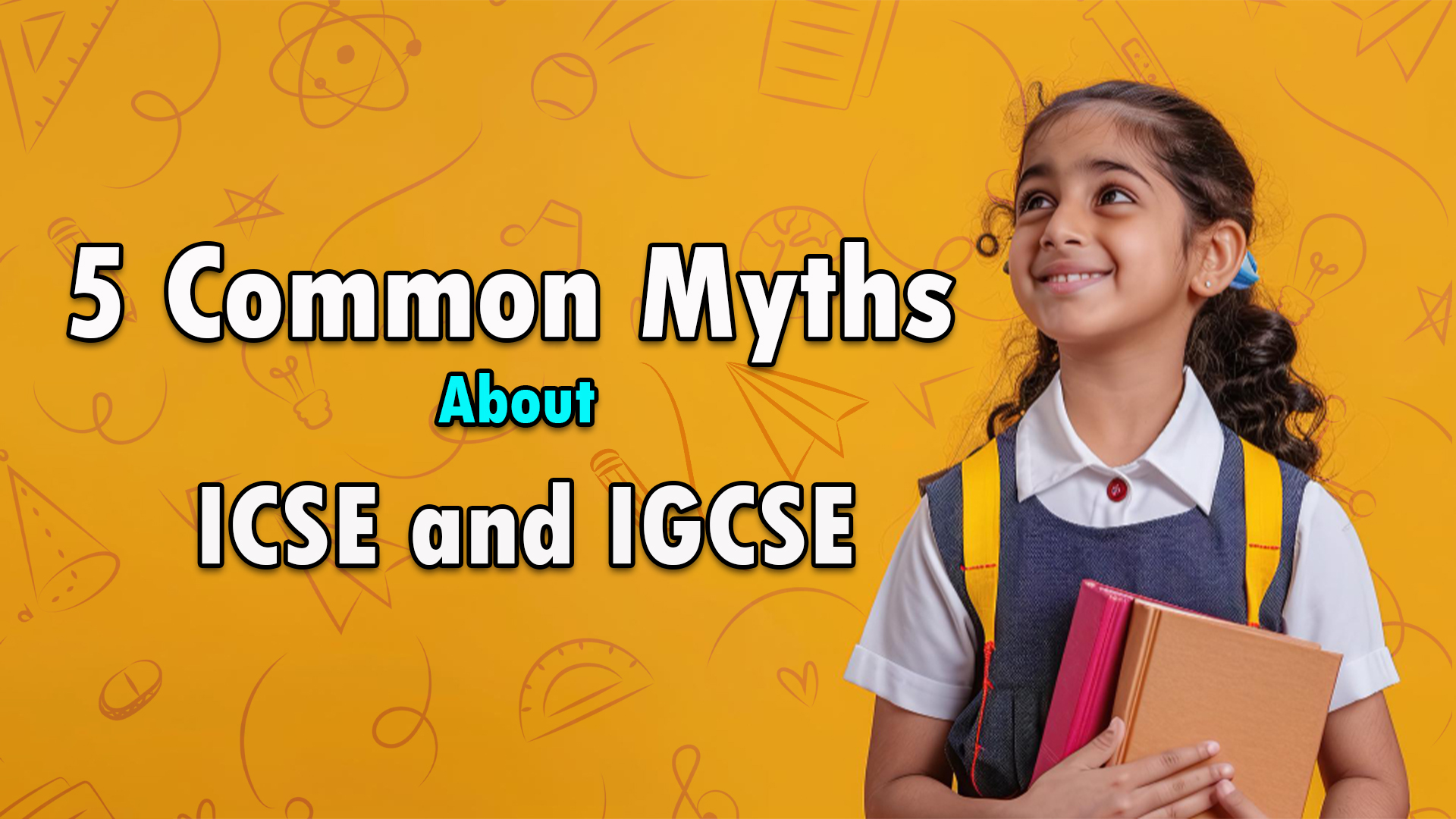
Introduction: Clearing the Confusion About Modern Education Boards
If you’re a parent comparing school boards, you’ve probably heard it all,
“ICSE is too tough.”
“IGCSE doesn’t fit Indian exams.”
“CBSE is the only board that helps with NEET and JEE.”
These sweeping statements often come from half-truths, old assumptions, or misinformation. The truth is, each board is designed with a distinct purpose, and what matters most is how it aligns with your child’s strengths, learning style, and long-term goals.
Let’s separate myths from facts — so you can make an informed, stress-free decision about your child’s education.
Myth 1: ICSE is too tough for my child
The Truth: It’s not tougher, it’s deeper.
The ICSE board isn’t “harder” than others; it simply values conceptual clarity and application over rote memorization.
Where some boards might prioritize quick recall, ICSE encourages students to understand the ‘why’ behind every answer.
That depth often gets mistaken for difficulty. In reality, ICSE’s approach helps students:
- Develop strong foundations in language, science, and mathematics
- Gain confidence in expressive writing and comprehension
- Prepare naturally for advanced study in any board or stream
Here, subjects are suited to every learner, not just toppers. Regular formative assessments, project support, and peer collaboration make the curriculum manageable and enjoyable, not overwhelming.
Why It Matters
Parents often notice that ICSE students develop better articulation and analytical thinking, skills that stay valuable long after exams.
So no, ICSE isn’t too tough. It’s thorough, thoughtful, and transformative.
Myth 2: IGCSE doesn’t help with Indian exams
The Truth: IGCSE builds stronger problem-solving skills that actually help with entrance exams.
One of the biggest misconceptions about IGCSE is that it “doesn’t align with Indian competitive exams.”
In reality, IGCSE strengthens the very skills those exams demand logic, reasoning, and application.
Unlike boards that lean heavily on textbook memorization, IGCSE focuses on concept mastery and analytical thinking, which are critical for success in exams like JEE, NEET, or SAT.
How IGCSE Helps with Indian Exams
- Deeper understanding of core concepts: Students grasp the “why” behind formulas and theories.
- Better time management: The IGCSE’s balanced assessment model trains students to manage varied question types efficiently.
- Global academic standards: The Cambridge curriculum ensures students can switch easily to Indian or international syllabi without gaps.
IGCSE learners adapt quickly when preparing for Indian entrance tests. They understand questions more intuitively because they’ve been taught to think critically, not memorize mechanically.
Bonus Advantage:
IGCSE students who later pursue higher education abroad find the transition seamless, as universities worldwide recognize and value Cambridge credentials.
Myth 3: These boards are only for rich or international students.
The Truth: They’re for families who value quality learning, not luxury.
It’s true that ICSE and IGCSE schools once had an elite image, but that era is long gone. Today, these boards are chosen by parents who prioritize strong academics, balanced growth, and global readiness, not just social prestige.
The misconception often arises because of the individualized attention and advanced infrastructure that many ICSE and IGCSE schools offer. But these aren’t luxuries, they’re essential elements of effective learning.
What You’re Really Paying For
- Qualified, trained teachers with international teaching certifications
- Smaller class sizes and personal mentoring
- Modern learning labs, project spaces, and STEAM integration
- Globally benchmarked assessments and Cambridge moderation
At Agasthya, accessibility is a core value. We believe every child deserves a world-class education grounded in Indian values — without making it a financial strain.
Our mission is simple:
To make global-quality education local, accessible, and meaningful for every learner.
So no — these boards aren’t for the rich. They’re for families who believe in learning without limits.
Myth 4: CBSE students score better in college entrance tests
The Truth: Scoring depends on preparation, not the board.
This is perhaps the most widespread myth among parents in India. While CBSE’s syllabus overlaps with certain entrance exam patterns, that doesn’t automatically make CBSE students “better scorers.”
ICSE and IGCSE students often excel in competitive exams because of their strong analytical, writing, and comprehension skills. These boards build a learning foundation that helps students:
- Solve unfamiliar problems logically
- Handle multi-step questions confidently
- Express answers clearly under pressure
Real Difference: Skills vs. Syllabus
| Focus Area | CBSE | ICSE | IGCSE |
|---|---|---|---|
| Syllabus Style | Straightforward & exam-oriented | Conceptual & detailed | Global, analytical & skill-based |
| Exam Pattern | National-level tests | Applied + theoretical | Varied (projects, orals, coursework) |
| Preparation Advantage | Familiarity with Indian exams | Balanced literacy & numeracy | Deep reasoning, flexible for Indian & global tests |
IGCSE students consistently perform well in competitive exams, not because of shortcuts, but because they understand the subject inside out.
In the long run, that comprehension becomes their greatest advantage.
Fact: Entrance exams reward logical thinking and conceptual clarity, and that’s exactly what ICSE and IGCSE nurture.
Myth 5: Project-based boards mean less discipline
The Truth: Project-based learning demands more accountability, not less.
This is one of the most misunderstood ideas about progressive education.
Parents often equate “projects” with “play,” assuming that if a child isn’t writing pages of notes, they aren’t learning seriously.
In reality, project-based learning requires time management, collaboration, independent research, and presentation skills all of which demand self-discipline.
What Makes Project-Based Learning Rigorous
- Students must meet multiple deadlines (drafts, research reports, and final presentation).
- Projects are assessed through rubrics, evaluating depth, creativity, and reflection.
- Group tasks teach responsibility, leadership, and teamwork life skills that exams can’t measure.
In IGCSE, coursework and projects are often externally moderated, ensuring authenticity and academic integrity.
ICSE also incorporates internal assessments that teach accountability from an early stage.
At Agasthya, our classrooms blend both structure and creativity, where discipline is self-driven, not fear-driven.
Discipline isn’t about silence; it’s about responsibility.
And project-based boards cultivate precisely that.
What Parents Should Really Look For
Choosing a board is important, but it’s not everything.
Even the best curriculum can fall flat if teaching quality, values, and school environment don’t align with your child’s needs.
Here’s what truly matters beyond board labels:
1. Teaching Quality
A curriculum is only as effective as the teachers delivering it.
Look for schools that invest in teacher training, mentorship programs, and global teaching certifications. At Agasthya, all educators undergo Cambridge and IB training modules, ensuring teaching practices match international standards.
2. Learning Environment
A school’s atmosphere should encourage curiosity, not competition.
Small class sizes, open discussions, and supportive classrooms create confident learners. IGCSE environments are intentionally designed to make students enjoy learning, not fear tests.
3. Values and Emotional Support
Academic success means little without emotional balance.
Boards like IGCSE emphasize holistic education, empathy, ethics, and cultural understanding, preparing students for life, not just exams.
At Agasthya, we integrate mindfulness, mentorship, and life skills into daily learning so that education remains both human and high-quality.
Why IGCSE Stands Out — Subtly but Surely
While both ICSE and IGCSE value practical understanding, the IGCSE framework adds a global dimension. It prepares children for a borderless future, where skills matter more than systems.
- Flexible subject choices that fit each learner’s profile
- Globally standardized assessment methods
- Recognition by top universities in India and abroad
- Emphasis on critical thinking, communication, and collaboration
Parents who’ve transitioned their children into IGCSE often notice a shift from stress to confidence, from memorization to curiosity, from grades to growth.
That’s the power of a curriculum designed for the world their children are growing into, not the one we grew up in.
Conclusion: From Myths to Meaningful Choices
Every parent wants the same thing a confident, capable, and happy child.
ICSE and IGCSE are not “difficult” or “exclusive” boards; they are modern frameworks that prioritize real understanding over rote memorization.
As education evolves, so should our perceptions.
The real question isn’t “Which board is easier?”, it’s “Which board prepares my child for the world ahead?”
At Agasthya Public School, we believe the answer lies in balanced, inquiry-based learning that fosters clarity, creativity, and confidence.
That’s why our IGCSE and ICSE programs are designed not just to educate, but to empower.
FAQs
Q1. Is IGCSE recognized in India?
Absolutely. IGCSE is recognized by the Association of Indian Universities (AIU) as equivalent to Grade 10 in Indian boards. Students can easily continue to Grade 11–12 in CBSE, ICSE, State, or international schools.
Q2. Does ICSE have the same global value as IGCSE?
ICSE is well-respected across India and Commonwealth countries, especially for its English and conceptual strength. However, IGCSE’s recognition is wider globally, making it more adaptable for international studies.
Q3. Will my child face difficulty shifting from IGCSE to the Indian boards later?
Not at all. IGCSE’s conceptual clarity makes transitions smoother. Many students move to Indian boards with ease because their foundation in logic and application is already strong.
Q4. Are ICSE and IGCSE schools only focused on academics?
No. Both boards promote balanced development through co-curriculars, arts, sports, and leadership opportunities — fostering well-rounded growth.
Q5. How can parents support IGCSE-style learning at home?
Encourage exploration and discussion. Ask open-ended questions, help children research topics independently, and celebrate progress — not just grades.